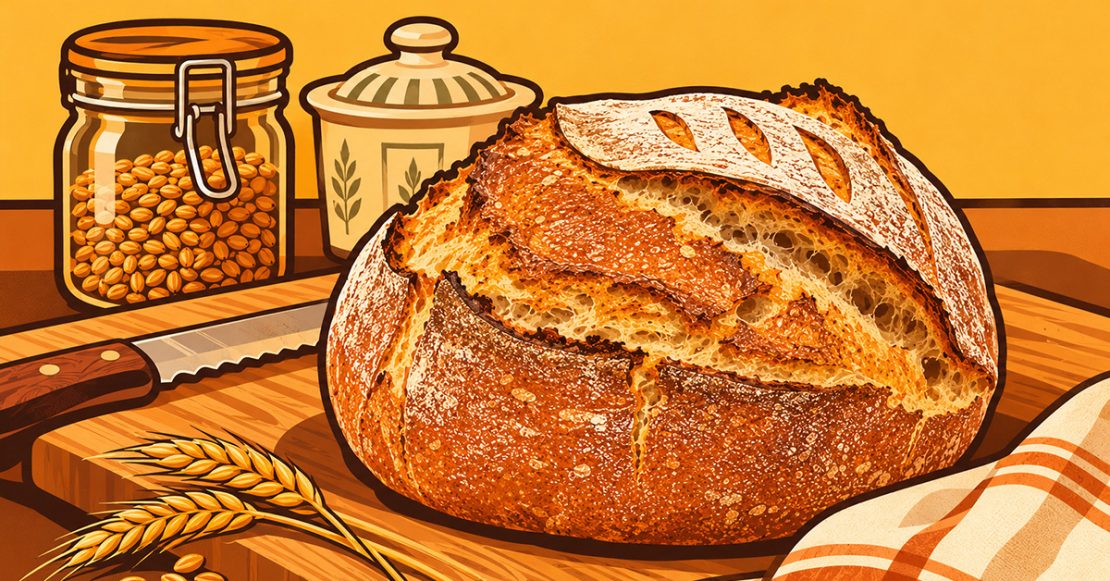


Flour, water, salt and a little starter. Mix it in the evening, bake it in the morning. A quick stretch and fold, then a long, quiet rise.
This loaf is built on two of our stone-milled flours. Revivalist Bread Flour gives it a strong rise and an open crumb. Hard White Wheat Flour, single-origin from one farm in Dighton, Kansas, adds nutrition and a mild, sweet flavor with no bitter edge. The Dutch oven gives it the crust.
If you’re new to sourdough, start here. Your hands are in the dough for a few minutes. The starter does the rest while you sleep.
Download the printable recipe (PDF)
Makes: 1 loaf · Rest: 30 to 45 min · Rise: 9 to 13 hrs total · Bake: 50 min, 450°F then 425°F
Why You’ll Love This Recipe
- Two flours, one loaf. Strength from Revivalist, nutrition and mild sweetness from Hard White.
- Stretch and fold. A few quick folds build the structure.
- Overnight rise. Mix after supper, bake after breakfast.
- Crackly crust. A lidded Dutch oven traps the steam.
- Uses your discard. Starter fed 12 to 24 hours earlier is just right.
- Beginner friendly. Short hands-on time, forgiving schedule.
Ingredients
- 65 g sourdough starter (about ¼ cup), fed 12 to 24 hours earlier
- 350 g filtered water (about 1⅔ cups), warm, around 100°F
- 350 g Revivalist Bread Flour (about 3 cups)
- 150 g Hard White Wheat Flour (about 1¼ cups)
- 9 g fine sea salt (about 2 tsp)
Instructions
- Mix. Stir the starter into the warm water until dissolved. Add both flours and the salt and stir until a shaggy dough forms. Finish by hand until no dry flour remains.
- Rest. Cover the bowl with a damp towel and let the dough sit 30 to 45 minutes.
- Stretch and fold. Lift one edge about 4 inches, fold it into the center, and give the dough a quarter turn. Repeat all the way around. Cover and wait 30 minutes to an hour between sets. Do at least four sets, or keep going until the dough passes the windowpane test.
- Overnight rise. Leave it at room temperature 8 to 12 hours, until doubled and bubbly on top and underneath. Do not refrigerate.
- Shape. In the morning, turn the dough onto a lightly floured counter. Shape the loaf. Let it rest 10 to 15 minutes.
- Final rise. Line a medium bowl with a towel, or use a banneton, and dust it heavily with rice flour. Set the dough in seam side up and let it rise 45 to 60 minutes. Preheat the oven to 450°F during this rise. Do not preheat the Dutch oven.
- Score. Lay a long sheet of parchment over the bowl and flip the dough onto it. Score the top with a lame or sharp knife. Use the parchment to lower the dough into a 4 to 5 quart Dutch oven.
- Bake. Bake covered 30 minutes at 450°F, then uncovered 20 minutes at 425°F. The center should read 195 to 205°F.
- Cool. Cool on a wire rack at least one hour before slicing.
Tips for the Best Overnight Sourdough
- Check your starter: A healthy starter doubles within 4 to 6 hours of a feeding. Not sure? Drop a spoonful in water. If it floats, it’s ready.
- Use filtered water: Chlorine in tap water can slow fermentation. Tap water left out for 24 hours works too.
- Feel the dough: Stone-milled flour drinks more water than commodity flour. If the dough feels stiff after the rest, work in water a tablespoon at a time.
- Mind the temperature: At 75°F the overnight rise takes about 8 to 10 hours. At 70°F, 10 to 12. Cooler rooms take longer. Watch the dough, not the clock.
- Doubled is done: Dough left well past doubled turns slack and spreads flat. A clear bowl makes the bubbles easy to see.
- Protect the bottom crust: Dark Dutch ovens brown the bottom fast. A silicone baking round or a dusting of cornmeal under the parchment helps.
- Let it cool before slicing: The crumb is still setting. Cut it warm and it turns gummy.
Serving Suggestions
A good sourdough loaf goes with almost everything. Tear it beside a bowl of soup or stew and let it soak up the broth. Toast a thick slice and top it with avocado, or butter and jam. Build a grilled cheese with real tang. Or set it out with good olive oil and salt and call it supper. The crust holds up, the crumb stays tender.
Frequently Asked Questions
Can I use starter discard?
Yes. The starter should come from an active, established culture, fed 12 to 24 hours before you mix. It doesn’t need to be at its peak.
Do I need a Dutch oven?
Any heavy, oven-safe pot with a tight lid will work. Look for one about 9 to 10 inches across, with the pot and lid rated to at least 450°F.
Can I use just one flour?
Yes. Either flour works on its own at 500 g. Together, Revivalist brings the strength and Hard White brings nutrition, a milder, sweeter flavor and a paler crumb.
Method adapted from The Feathered Nester’s Easy Overnight Sourdough Bread.


