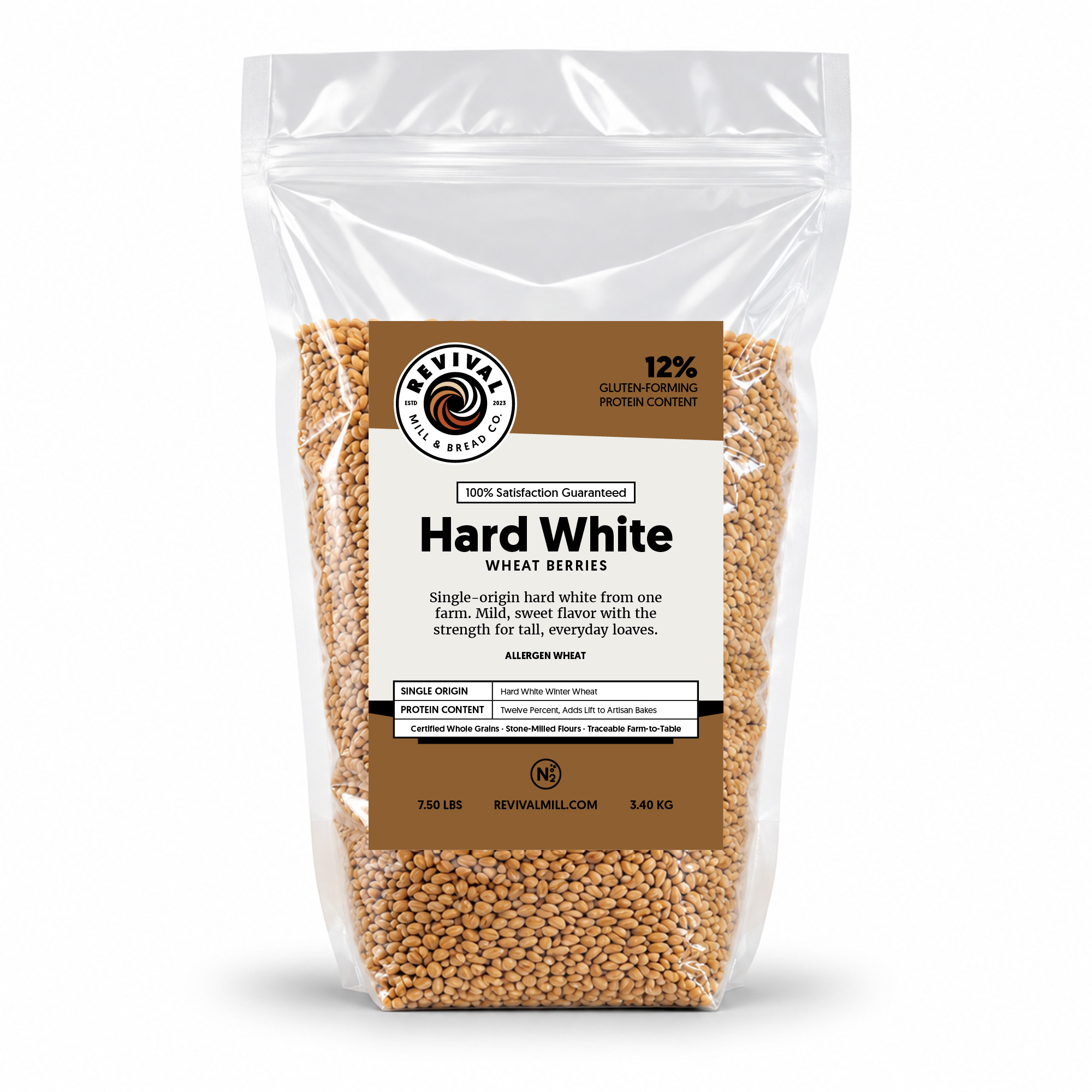
Hard White Winter Wheat Berries from Revival Mill & Bread Co.

Description

Hard White Winter Wheat is the everyday bread wheat, with the strength of hard red and none of its bitterness. Ours is KS Silverado, a variety bred at Kansas State University, grown on a single farm in Dighton, Kansas, and harvested on its own. It reaches you as whole berries, so you mill it fresh when you’re ready to bake.

Milled fine, it makes a light-colored whole wheat flour with a mild, slightly sweet flavor. It has the same strength as hard red for a tall, open loaf, but its pale bran lacks the bitter edge of red wheat, which makes it the easiest way to bake whole wheat bread that doesn’t taste heavy. These are the same berries we mill for our Hard White Wheat Flour. Use it for sandwich loaves, sourdough, rolls, and pizza dough. Cooked whole, the berries stay chewy and nutty in soups, pilafs, and grain salads.

How to Bake with Hard White Wheat Flour

Fresh whole wheat flour drinks more water than store-bought white flour, and Silverado absorbs more than most, so start with a little extra liquid and adjust as you mix. Let the dough rest 20 to 30 minutes after mixing so the bran can soften and the gluten can develop. If you’re new to whole wheat, start by replacing half the flour in a favorite recipe with fresh-milled hard white, then work up from there.

Hard White Wheat Berries at a Glance
  • KS Silverado Hard White Winter Wheat Berries, whole grain.
  • 12% gluten-forming protein for dough strength and a good rise.
  • Mill into flour for bread, or cook whole for salads, pilafs, and soups.
  • 7.5 lb bags are vacuum sealed with a nitrogen flush. The 15 lb size ships as two 7.5 lb bags.
  • 2.5 lb size comes in a recycled kraft paper bag with a plant-based PLA liner.
  • For the most nutrition and freshness, mill your own flour.
  • Non-GMO and glyphosate free.
  • Backed by our 100% Satisfaction Money-Back Guarantee.
The Story of KS Silverado

For most of the last century, the Great Plains grew hard red winter wheat. Its red bran gave whole wheat flour a darker color and a bitter edge, so most of it was sifted into white flour before it reached the kitchen. In 1987, wheat breeders at Kansas State’s research center in Hays, Kansas, began turning their work toward hard white wheat, and by 1998 the program was devoted almost entirely to it. In 1990, hard white was recognized as its own class of wheat.

White wheat has one weakness red wheat doesn’t. When rain comes near harvest, it can sprout right in the head, which ruins it for baking. KS Silverado was bred at Hays to hold up against that. It came from a 2008 cross of three Hays hard white lines and spent eleven years in development and field trials across Kansas before its release in 2019. It resists sprouting, stands up well in the field, ripens early, and bakes well as both white and whole wheat flour. Today it grows in Dighton, less than a hundred miles from where it was bred.

Whole Berries for Your Home Mill

This is a single-origin grain, not a blend. You know what it is, you know where it grew, and you decide when it becomes flour. Whole berries keep far longer than flour, and our nitrogen-flushed 7.5 lb bags push out the oxygen insects need. Keep a supply on hand, mill what you need, and bake with flour that’s minutes old instead of flour that sat on a shelf.

  • Single Origin: KS Silverado hard white winter wheat from one farm in Dighton, Kansas.
  • Built for Home Milling: Clean, whole berries ready for your home mill.
Life is short. Make good bread.

Allergen Notice: Contains wheat.

Origin

  • Hard White Winter Wheat
    Dighton, KS

Frequently Asked Questions

Visit our Shop page, select your items, and follow the checkout prompts. You can choose shipping or local pickup where available.

Dry Goods (flours, berries, and mixes): Packed Tuesdays; ready for pickup or shipment the next business day (Wednesdays).

Wednesdays between 9:00 AM and 5:00 PM at:

Spare Feet Shops, 14601 Soncy Rd, Amarillo, TX

We ship to the lower 48 states and can deliver to U.S. military APO/FPO addresses. For shipping outside these areas, please Contact us for a custom rate.

All prices are listed in USD and must be paid in full at checkout. We use Stripe as our secure, trusted payment processor (credit/debit cards). Your payment information is never stored on our servers.

Email us at [email protected] or call/text (806) 221-2130 before 5 PM the day prior to your scheduled Tuesday packing date.

Yes—sourced from non-GMO seeds; grown without chemical defoliants (including glyphosate).

We offer white, high-protein, red, and black sorghum. Though not certified organic, our sorghum is naturally gluten-free, non-GMO, grown without chemical defoliants, and never treated with storage chemicals or storacides. It’s single-origin and responsibly farmed. We mill everything from fine-sifted flour to polenta-style grits. Our sorghum flours and grains have been featured by the National Sorghum Producers, the Culinary Institute of America, and Texas Tech University’s Department of Nutritional Sciences.

No. Our grains and mixes are never treated with storage chemicals or storacides. Our berries are vacuum-sealed with a nitrogen flush, which pushes out the oxygen insects need and keeps the grain in good shape for long-term storage.

If your order arrives damaged or incorrect, notify us within 24 hours of delivery and we’ll make it right.

We do not accept returns on food products. If there is an issue with your order—damage in transit, incorrect item, etc.—please reach out within seven days of delivery, and we will work to make it right.

We source only certified seed or work directly with trusted growers who follow strict standards for varietal purity, field management, and post-harvest handling. This ensures our wheat, sorghum, corn, and other grains maintain consistent quality, traceability, and performance. From seed to storage, we prioritize identity preservation so every batch meets the standards needed for clean milling and dependable results in the kitchen.

Our single-origin grains are responsibly grown—hard and soft red wheat from Texas farms, hard white wheat from Kansas, soft white wheat from Washington. We work directly with growers who practice responsible and sustainable farming—no chemical defoliants, no storage pesticides—so you get full-flavor, nutrient-rich grains.

Stone-milling is a slow, cool process that keeps the grain's natural oils and flavor, yielding flour with fuller flavor, higher nutrition, and a natural texture. We use a Bakers Grade™ mill from New American Stone Mills—trusted by professional bakers worldwide—to ensure consistency and taste.

We mill every bag to order. Once you place your order, we grind the grains fresh—on demand—so that what you receive is peak flavor and performance. Expect noticeably brighter taste and aroma compared to mass-produced flours.

It would be better that you did, especially while you’re learning to use fresh-milled flour. After the learning curve, you can usually go back to your old recipes. The ratio of flour:water:fats is usually different in fresh-milled flour recipes.

All grains and flours ship in GrainPro® Hermetic Bags—water-resistant, gas-tight, food-grade pouches that protect contents from moisture, pests, and mold without pesticides or refrigeration. These eco-friendly, reusable bags ensure your grains and flours arrive fresh and ready.

By weight, yes—1 oz of stone-milled flour equals 1 oz of regular flour. By volume, though, stone-milled flour packs more densely, so cups can vary, but usually one cup of grain equals two cups of flour. For consistent results, weigh your flour and increase hydration by about 10–15% over standard recipes to accommodate its extra water absorption.

Yes, generally speaking, it's best to bring frozen flour up to room temperature before using it.

Fresh-milled flour stays good in the pantry for about three weeks when kept in an airtight container in a cool, dry place; beyond that, freeze it to preserve freshness and prevent rancidity.

is our house standard across the line: sifted flour at about 75% extraction, meaning we keep roughly three-quarters of the milled grain and sift out the coarsest bran. It runs denser than ultra-fine "00" flour but stays refined enough for dependable performance. Stone-milling keeps the oils, nutrients, and flavor that industrial milling strips out, so you get real depth of flavor with consistent bakes.

Yes. We provide custom pricing for bulk orders of stone-milled flour and whole grain berries. If you operate a bakery, café, retail shop, or meal-kit service in Lubbock, Amarillo, or elsewhere, email [email protected] with your requirements. We’ll supply volume pricing, packaging options, and delivery logistics.

No, our grains aren’t certified organic—most growers opt out because organic certification brings complex regulations, higher costs, and often lower yields. Instead, we partner with farmers who use regenerative, sustainable practices to deliver the freshest, most flavorful grain.

Absolutely. If you own a home mill, we offer responsibly sourced whole grain berries in various sizes. Be sure your mill can handle the hardness of each grain (e.g., wheat vs. sorghum).

We mill only one grain at a time to minimize cross-contact. However, our facility processes wheat, rye, and sorghum, so we cannot guarantee a 100% allergen-free environment. If you have severe allergies, please contact us before ordering.

If your question isn’t answered here, email us at [email protected]. We aim to respond within one business day. For faster response, put “Customer Question” in the subject line.